
Yes … Everyone
Steve Spangler does not turn it off.
I have watched him engage a server at a restaurant, someone walking by on the street, an audience member in the back row. He does not save his energy for the stage. He brings the same curiosity, the same attention, the same genuine interest to every interaction. That is not performance but probably more internal wiring.
We are both members of the Speakers Roundtable, and I recently sat down with my friend Steve to talk about his new book, The Engagement Effect: Cultivating Experiences that Ignite Connection, Build Trust, and Inspire Action. You can listen to that conversation. But what the recording cannot capture is what I have observed over years of knowing him. Steve lives what he teaches. Engagement is not something he does when the camera is on or when he is getting paid. It is how he moves through the world.
That matters for leaders because most of us compartmentalize. We engage when it counts and we save our best energy for important meetings. We show up differently for executives than we do for staff. Steve does not operate that way.
-
Curiosity is the engine of connection
Steve’s engagement always starts with genuine curiosity. He asks questions that are not scripted or strategic. He wants to know. When he meets someone, he is not waiting for his turn to talk. He is discovering who they are, what they care about, what makes them light up.
I watched him spend fifteen minutes with a waiter asking about the restaurant’s most unusual customer request. The waiter started the conversation transactionally and ended it energized, telling Steve things he probably had not shared with anyone in months. That shift happened because Steve asked questions that assumed the person in front of him had something interesting to offer.
Most leaders ask questions to extract information they need. Steve asks questions because people fascinate him. The difference is subtle but profound. One treats people as resources. The other treats them as whole human beings worth knowing.
-
Attention is the gift you give
Before Steve says anything, he gives attention. Full attention. Not the kind where you are present physically but scanning the room mentally.
I have seen him stop mid-stride when someone approaches him on the street. He does not glance at his phone or over their shoulder at what is next. He stops. That creates a moment where the other person feels seen, not processed.
He and his wife both did the same when he met my wife and the four of us had dinner. Laser-focus. No doubt he was engaged (and you can’t teach engagement if you aren’t first engaged!)
In leadership, we underestimate how much people notice where our attention goes. We think we hide our distraction better than we do. Employees know when you are half-present in a conversation. They know when the one-on-one is something you are enduring rather than valuing. Steve’s presence is a reminder that attention is one of the most powerful tools a leader has.
-
Engagement requires lowering your status
Steve is famous. He has been on television more times than most people will ever speak in public. He has a Wikipedia page. He has billions of YouTube views. None of that shows up in how he engages people. He does not lead with credentials or accomplishments. He leads with curiosity and humor that lowers his status intentionally, creating space for others to rise.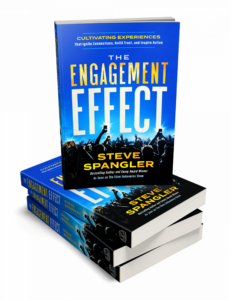
I watched him ask a hotel employee for advice on where to eat, treating the recommendation like insider intelligence. That investment happened because Steve made the interaction feel important, and he did that by positioning himself as someone who needed help rather than someone important.
Leaders who carry their status into every interaction create distance. Leaders who temporarily set it aside create connection. Steve understands that engagement requires making yourself accessible, not impressive.
-
Partnership multiplies what you can do alone
I have watched Steve interact with his wife Renee, his high school sweetheart who serves as CEO of their company. They are inseparable. They finish each other’s sentences. They know each other’s strengths so well that collaboration looks effortless though I know it is anything but.
What strikes me is how they engage as a team. Where Steve brings creative energy and public presence, Renee brings operational excellence and strategic clarity. Neither diminishes the other. That partnership extends beyond their marriage into how they lead their organization, modeling what engagement looks like when two people truly see and value what the other brings.
Most leadership partnerships struggle because ego gets in the way or because people compete rather than complement. Steve and Renee have built something rare…a relationship where engagement is not just outward-facing toward customers and audiences, but inward-facing toward each other.
Leaders who want to build cultures of engagement must start with their own partnerships. If you cannot engage well with the people closest to you, the rest is performance.
-
Small moments compound into culture
Steve does not wait for big stages to engage. He does it constantly, in moments that seem insignificant. A quick conversation in a hallway. A comment to a stranger who looks lost.
The moments compound. Over time, those small engagements build a reputation, a culture, a way of being that others notice and often emulate. Leaders shape culture not primarily through vision statements or town halls but through the thousand small interactions that reveal what they actually value.
If you engage only when stakes are high or audiences are large, you teach your organization that engagement is transactional. If you engage consistently regardless of context, you teach them that people matter regardless of their role or utility to you. Steve’s consistency is the lesson. Engagement cannot be selective if you want it to become cultural.
-
Engagement transforms the person giving it
 I have noticed something about Steve that I did not expect. He seems energized by engagement, not drained by it. Let me redo that: he is definitely engaged by it. Most leaders talk about people interactions as expenditures. They budget their energy carefully, preserving it for what matters most. Steve seems to gain energy from the very interactions that would exhaust others.
That aligns with what he writes about in “The Engagement Effect.” Engagement is not a finite resource you deplete. It is a practice that refills you even as it serves others. The leader who dreads one-on-ones or avoids hallway conversations is probably engaging transactionally, treating people as tasks to complete. The leader who finds energy in those moments is engaging relationally, seeing people as sources of discovery rather than drains on capacity.
This reframe matters. If engagement depletes you, you will ration it. If it energizes you, you will seek it. Steve has figured out how to make engagement generative rather than extractive, and that makes him sustainable in ways most high-performers are not.
-
Surprise breaks patterns that create disengagement
Steve’s background in science demonstrations (and in magic!) taught him something most leaders miss. Surprise resets attention. When people expect one thing and experience another, they wake up. Their brains reengage. Surprise interrupts the autopilot that most of us operate on most of the time.
I have watched him do this in conversations. He will say something unexpected, ask a question from an unusual angle, or introduce an idea that does not fit the script people assumed the conversation would follow. That surprise signals that this interaction will not be predictable.
Leaders often prioritize predictability because it feels professional. Meetings follow agendas. Conversations follow scripts. How uttery boring! That predictability makes things efficient, but it also makes them forgettable. Steve’s willingness to surprise people makes his engagements memorable. People walk away changed and not just informed.
-
Engagement is a practice, not a personality trait
The most important lesson from watching Steve is this: engagement is not something you either have or lack. It is something you practice. Steve has practiced it for decades, through thousands of interactions, until it looks effortless. But it started as a choice.
That means the rest of us can learn it. You do not need to be naturally extroverted or charismatic. You need to decide that people matter enough to give them your full attention. You need to practice curiosity even when you are tired. You need to lower your status intentionally even when ego resists. You need to look for opportunities to surprise.
And here’s a bonus: Steve engages well because he is a genuinely nice guy. That comes through fast. People are drawn in because he’s warm and personable and that creates engagement. People want to be part of what he’s doing.
Steve Spangler‘s genius is not that he is different from other leaders. It’s just that he has practiced engagement so consistently that it has become who he is. The gap between who he is on stage and who he is in a hallway has disappeared because he refuses to let context determine whether someone deserves his full presence.
That is the standard. Not perfection. Consistency.
Get the book: The Engagement Effect: Cultivating Experiences that Ignite Connection, Build Trust, and Inspire Action.