
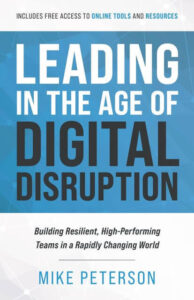
Most leadership books either offer great ideas with little guidance or practical steps without the bigger picture. Leading in the Age of Digital Disruption by Mike Peterson offers both the great ideas with the practical steps. It’s a compelling playbook for anyone navigating digital leadership in hybrid workplaces. If you lead a distributed team, manage change, or are rethinking how to build trust in today’s workplace, this book gives you both the strategy and the structure to do it well.
The book opens with the fictionalized story of Ethan Caldwell, a CHRO promoted to CEO of Brightpath Solutions in the middle of a corporate mess. Brightpath is on the edge of collapse. Ir is suffering from a broken culture, a trust deficit, and leadership that put results above people. As Ethan steps into the top job, we watch him confront what many leaders face today: hybrid teams, global complexity, and the erosion of accountability.
In the second half of the book, Mike pulls back the curtain. He breaks down what it means to build trust, communicate transparently, and lead through crisis. This isn’t theoretical. Mike has spent his career consulting and advising global companies on leadership, IT, and HR, and he brings these lessons into the light for all of us.
His experience working across countries and helping leaders comes through in his story and in his tips.
As CHRO, Ethan wasn’t the obvious choice for CEO. Have you seen examples in your work where an unconventional promotion sparked change?
 Absolutely—I’ve lived it personally. While leading HR at a growing biotech company, I was promoted to take on IT as well. It raised eyebrows as people weren’t sure what to make of someone overseeing both people and technology. But I approached IT the same way I approached HR: by focusing on how we add value to the business. Our team built systems with the understanding that even the best technology only works when people are supported, aligned, and engaged. That approach earned us rave reviews. We consistently heard we were the best IT team people had ever worked with.
In the Capital Grille scene with Tanya Grayson, Ethan realizes he’s being interviewed without knowing it. Have you ever experienced a moment like that in your career?
Yes—several times. Some of the most pivotal career moments I’ve had weren’t formal interviews, but casual conversations where a decision-maker was evaluating how I think and lead.
Like Ethan, I’ve learned that you’re often being considered for a role long before anyone brings it up directly.
You write that “what we permit, we promote.” Can you share an example of that principle in action?
At one client company, the executive team was told they were trusted and empowered to lead their teams. One voice in that group consistently dominated the discussion, often overruling others, even in areas outside their expertise. The rest of the team felt their strategy was being dismissed, but the CEO allowed it to continue. Over time, this created confusion around decision-making and discouraged real accountability. Even though this was against how the CEO wanted the group to operate; by permitting it, he promoted a culture where expertise was ignored, and confidence in the direction of the company eroded.
One of your core messages is about building trust. You define it in a very specific way. Why did you decide to define it so precisely, and how has that shaped your own leadership?
I’ve worked at companies where the word “trust” has been misused and weaponized. Trust is just a vague buzzword unless we clearly define it in a way that everyone can understand. In LEADING IN THE AGE OF DIGITAL DISRUPTION, trust is defined as a mutual belief in each other’s reliability, integrity, and intentions. That clarity gave Ethan—and gives real leaders—a concrete foundation to build from. It’s helped me in global leadership by setting shared expectations, regardless of culture or role.
The fictional company Brightpath is hybrid and global. What are the biggest mistakes you see leaders making with remote teams?
Assuming presence equals performance. At many of my clients, in-office employees unintentionally got more visibility and influence, while remote workers felt like second-class contributors.
Ethan’s approach is to observe first. He listens in on meetings, watches body language, and notes energy. Why is observation such a rare but critical leadership skill?
Leaders are often rewarded for acting, not for listening. And listening requires one thing many leaders feel they can’t spare: time. When new leaders step in, they’re eager to make an impact and bring in their own ideas. But without context and change management, even great ideas can miss the mark. Observation helps leaders understand what’s already working, where the real gaps are, and how the team functions.
Your chapter “The Burnout Leader” is subtle but powerful. How can leaders tell if they’re burned out themselves?
One sign is when leaders stop delegating and revert to individual contributor mode, also known as working harder instead of working smarter. At Brightpath, leaders who were overwhelmed didn’t trust their teams to deliver. Burnout often shows up as control, isolation, and reactive decision-making.
How do you coach leaders to lean into conflict in a healthy way?
I coach leaders to see conflict not as a threat, but as feedback, or two different perspectives coming together to create something better. I encourage them to surface tensions early, ask tough questions, and stay grounded in trust and shared purpose. Healthy conflict leads to clarity, not division. The goal isn’t comfort, it’s alignment. And while this approach can feel uncomfortable at first, with practice it becomes a natural and productive part of leadership.
Brightpath’s hybrid meetings lack energy. How do you help leaders energize distributed teams?
Structure and presence make all the difference. I coach leaders to start with a clear purpose for every meeting, rotate facilitation roles, and intentionally create space for all voices, especially the quieter ones. Shifting from passive status updates to active, intentional dialogue transforms the energy in the room, even virtually.
And sometimes the simplest fix is the most effective: turn your video on. Visibility builds connection.
In a time when remote work, trust deficits, and complexity define the workplace, leadership must evolve. Leading in the Age of Digital Disruption isn’t just another business book—it’s a practical field guide for modern leadership. Whether you’re stepping into a senior role, rebuilding a fractured culture, or managing across borders and time zones, the lessons from Mike Peterson are clear, real, and ready to implement.
Learn more or grab your copy here:
Leading in the Age of Digital Disruption
Image Credit: lanju fotografie