
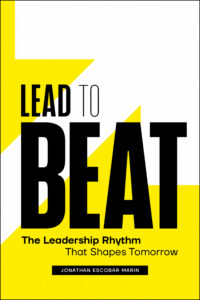
Jonathan Escobar Marin asks a blunt question that many leaders quietly wrestle with. Why do capable companies stall when talent, strategy, and technology are all in place?
His answer is not abstract. He names the forces that quietly erode momentum. Fragmentation. Ambiguity. Turbulence. Entropy. Together, they form what he calls FATE. Anyone who has sat through another slide deck while decisions slide another quarter down the road will recognize it.
Jonathan’s perspective is grounded in lived experience. He left school at sixteen. He built, advised, and led companies across five continents. He has seen growth collapse under complexity and watched clarity restore it. What emerges in Lead to Beat: The Leadership Rhythm that Shapes Tomorrow is a practical execution system.
I asked him to share some of his observations.
You open up Lead to Beat talking about forces and unpredictability. Give us a sense of what you see as some of the major trends disrupting business.
Market power no longer flows from size but from speed.
Leaders navigate an unprecedented convergence where AI systems have evolved from content generation to autonomous planning and execution. Competition has shifted from semiconductor supply chains to AI compute access. Who controls the infrastructure powering advanced AI capabilities now defines competitive advantage as much as traditional resources ever did.
Meanwhile, social patterns are redefining markets. Remote work has moved from emergency response to preferred setup. Generational expectations around work-life integration, corporate purpose, and environmental accountability have become operational requirements. Consumer behavior that took decades to establish can pivot in quarters as social media accelerates preference shifts.
The gap between what technology enables and what organizations can absorb keeps widening. A well-funded startup can now accomplish in weeks what took established companies months just three years ago. Supply chains have regionalized along geopolitical lines. This is operational reality now, not emerging trend.
The disruption isn’t any single technology. How technological acceleration collides with established geopolitical realities, persistent economic structural changes, evolving social contracts, and organizational systems designed for different market conditions creates the challenge.
We call these external forces FATE: Fragmentation, Ambiguity, Turbulence, and Entropy. External forces that amplify internally when they encounter organizational inertia.
Today’s advantage is tomorrow’s anchor. Yesterday’s competitive moat is today’s prison. Last quarter’s winning formula is this quarter’s recipe for irrelevance.
Let’s get into the four elements: fragmentation, ambiguity, turbulence, and entropy. How did you develop these? Talk about this model.
FATE emerged from patterns we observed across transformation work around the world. External forces weren’t just challenging organizations; they were amplifying internally in ways that undermined even strong leadership.
Fragmentation hits first, externally. Markets that were unified are splintering across channels, geographies, and customer segments faster than strategy cycles can adapt.
 Internal amplification follows a precise pattern: when that external fragmentation meets organizational structures without brutal focus, it multiplies into departmental silos. A clear market strategy becomes multiple departmental interpretations. Cross-functional collaboration, the very capability needed to respond to external fragmentation, breaks down. Information concentrates in silos instead of flowing. The same external force that should unite the organization in focused response instead fractures it into competing priorities.
Ambiguity compounds externally through contradictory market signals and shifting stakeholder expectations. Internally, without a single source of truth (what we call the Wall of priorities), it triggers paralysis. In organizations we’ve studied, strategic projects delay because multiple different success definitions emerge for the same initiative. Accountability becomes opaque. Everyone shares responsibility, so no one owns outcomes.
Turbulence accelerates externally through persistent geopolitical and social tensions. Markets that were predictable have become dynamic. Internal amplification manifests as activity without proportional impact. Motion replaces progress. In organizations without these disciplines, significant executive time gets consumed by non-outcome work, not by choice, but because organizational systems pull leaders into reporting instead of piloting. Meetings multiply. Process becomes bureaucracy. Activity buries impact.
Entropy operates differently: gradual but relentless. What was a breakthrough eighteen months ago is now standard. Market complacency emerges when past victories create comfort. Internally, without the disciplined drumbeat to evolve quarterly, it normalizes a victim mindset. What was competitive advantage becomes table stakes, but the organization still celebrates it as excellence.
FATE isn’t theory; it’s observable organizational physics. The model reveals something most frameworks miss: the challenge isn’t the external forces themselves. Leaders can’t control all external forces. How those external forces amplify internally when they encounter organizational inertia: that amplification is addressable.
Is there one that is more challenging than another for most companies?
Ambiguity.
Ambiguity undermines more strategies than any other external force.
Organizations pursuing priorities and strategies vaguely defined in long PowerPoints. When priorities are not crystal clear, nothing drives concentrated impact. Success gets defined multiple ways, so nobody can definitively win or lose. Accountability becomes negotiation instead of commitment.
Management teams leave strategy sessions energized after getting aligned around flip charts and PowerPoints. Everyone agrees. The plan feels clear. Watch what happens as that strategy cascades three levels down. By the time it reaches the teams who must execute, it’s fractured into competing interpretations. Marketing defines success one way. Operations another. Finance has different metrics. Key Account Manager leaders adapt it to their best interpretation of the situation. Functional experts filter it through their domain expertise.
Ambiguity is comfortable. It allows everyone to stay busy without confronting hard choices. It enables politics over performance. It allows mediocrity to hide behind activity. Leaders can point to motion, meetings attended, reports generated, AI pilots launched, while impact remains scattered.
The antidote isn’t pretending certainty exists; it’s building the operating system that converts external ambiguity into internal clarity. Clear priorities. Committed teams. Definitive timeboxes. Explicit trade-offs and a list of the things we are not going to do. Eliminating internal ambiguity doesn’t eliminate external uncertainty. It builds the organizational capability to navigate faster than competitors struggling with their own confusion.
You argue for a leadership ‘rhythm’ that links execution with evolution. What does that cadence look like week to week in a real company and how do you protect it when firefighting takes over?
The rhythm operates on two frequencies and three horizons simultaneously: weekly execution discipline and quarterly evolutionary cycles that balance the delivery of the quarter with building everything beyond the quarter. Exploitation and exploration. Many organizations and reductionism lovers default to short-term or long-term. The truth is simple: high-performing organizations maintain long-term focus with quarter evolution and short-term execution.
Weekly, the rhythm synchronizes around ten-minute transparent sessions where teams behaving as pilots report confidence in delivering on time, expose obstacles, and make real-time decisions. Not status updates. Not presentation theater. Actual obstacles surfaced. Decisions accelerated. Resources redirected to where impact’s being created or threatened.
Some people sometimes misunderstand the model. They hear “weekly” and think short-term focus. Incorrect. Weekly discipline is precisely what creates long-term advantage. Those who confuse high-frequency execution rhythm with short-term thinking probably also mistake a heartbeat for a human’s life purpose.
Weekly rhythm delivers continuous visibility into where value’s being created before quarterly reviews make it obvious. Problems surface in days, not quarters. Decisions happen in weeks, not months. The organization learns and adapts faster than competitors operating on longer cycles.
Quarterly, the rhythm intensifies through Keep, Improve, Start, Stop sessions. Teams refine the Wall based on what they’ve learned. What’s working gets amplified. What’s not gets stopped—actually stopped, not “deprioritized” into zombie status. New missions launch. The Stop Wall gets updated. The organization evolves without losing its identity, evolving in those priorities that will help deliver the targets of the quarter and those priorities that will define the future of the company in two, three, five, ten years.
This quarterly evolution operationalizes the “faster, stronger, leaner, better” mindset. Not aspiration but discipline. Every ninety days, the organization systematically evaluates what no longer serves and adopts what wins next.
When firefighting threatens the rhythm, maintaining it matters most. The drumbeat doesn’t pause for chaos; it converts chaos into clarity. Leaders understand where the fire is, how it might affect stability, and they give clear guidance about what and who so that the fire is contained with specific guidance and resources and doesn’t become the topic everyone in the organization addresses. The rhythm becomes the way to manage not only planned priorities but also unplanned disruption.
Skip it when things get busy, and you’re not saving time; you’re surrendering to chaos. Maintain it through turbulence, and you’re building the organizational capability that turns crisis into advantage.
You left school at sixteen. What edge did that nontraditional path give you and where did it force you to overcompensate?
Leaving school at sixteen forced an immediate confrontation with reality. I started cleaning CNC machines in a factory, but that “invisible position” gave me a front-row seat to conversations between operators, floor engineers, and white-collar staff. I witnessed firsthand how the gaps between their realities, priorities, and understanding affected our ability to deliver products on time, on budget, and to specification.
I learned that work matters more than theory. Execution matters more than words. On-the-job learning matters more than any plan. Most importantly, it taught me to value work, effort, and what it takes to bring money home every month: to honor it, not criminalize it.
When I had the opportunity to return to school (while working full-time night or morning shifts at the factory), I decided I wanted to solve that gap. At the time, I didn’t really know what that meant, but I thought it was something worth pursuing with passion.
That period also gave me the opportunity to build courage and resilience. When you’re sixteen, working alongside people who had already been there for twenty years before you were born, you learn how to survive and earn respect. Not through experience, age, or connections to powerful people, because you have none of these. Not through your role either, because I was just the guy cleaning machines and helping others with whatever they needed. Later, I didn’t have the opportunity to attend a school where I could build a professional network, learn English until I was older, or study at a well-known university. But I always had the ability to earn respect through the diligence of my work, attention to detail, and consistently going one step further than what was asked. You learn to be respected by honoring work, not demonizing it.
The overcompensation is working while others rest. Whenever people tell me, “Yes, but not everyone has your brain” or “You’ve been lucky,” I just laugh. I have neither an intelligence advantage nor, above all, a luck advantage. What I do have is the capacity to continue when others quit, when people stop trying, when people are exhausted. I am too, but I have the ability to push through until I deliver or learn how to deliver with a clear alternative approach.
Looking back, that nontraditional path gave me something formal education sometimes can’t: the ability to deliver without needing external support, continuous validation, recognition, or approval. More importantly, it taught me to deliver before asking. It surprises me to see so many people asking before they’ve shipped any value, or worse, people who ask but then can’t deliver anything at all.
The real gift was understanding that work is the most powerful force on the planet for changing lives. It changed mine, and it’s the only one that doesn’t depend on money, just effort.
What is the most counterintuitive practice in Lead to Beat that early adopters resist and later refuse to give up?
The Stop Wall: the explicit list of what you’re NOT pursuing.
Leaders resist it initially. Not because they don’t like the idea. They love it, but because they cannot stomach the discomfort of publicly declaring what you’re NOT pursuing. Triggers anxiety. What if we’re wrong? What if we miss the opportunity everyone’s chasing? What if the board questions our judgment? What if competitors pursue what we’re stopping?
This anxiety intensifies constantly. Every advisor, every board member gives you magic lessons about the choices that will transform your business. Every expert warns you’ll be left behind if you don’t pursue this and that. The pressure to pursue everything has never been stronger.
After implementation: clarity.
The Stop Wall is the back of the Wall of priorities: the explicit, company-wide list of what’s not being pursued. Eliminates shadow priorities that drain resources while delivering nothing breakthrough. Prevents the gradual addition of “just one more pilot” that fragments focus into sameness.
Organizations that implement it demonstrate something significant: clarity compounds. When everyone knows what’s NOT a priority, they stop second-guessing what IS. Cross-functional friction decreases because there’s less ambiguity about where resources flow. Talent stops getting pulled in multiple directions. The cognitive load that was constraining execution lifts.
The transformation is observable. Leaders shift from defending scattered priorities to protecting brutal focus. From anxiety about what they’re missing to confidence in what they’re winning. From “we should probably pilot that use case too” to “that’s on the Stop Wall for a reason. We’ve made our choice.”
Once they experience it, they become fierce defenders. Try to add something to the Wall without putting something on the Stop Wall? They’ll challenge you. Because they’ve learned what high-performing organizations know: winning isn’t about doing more; it’s about doing less, better, with singular conviction.
The Stop Wall also reveals organizational honesty. Many companies struggle with priority clarity. Everything’s important. Every initiative gets resources. Every team gets support. The Stop Wall forces truth. Resources are finite. Time is finite. Attention is finite. Choose.
That choice (that explicit, public, committed choice) is where strategy becomes operational. Where ambition meets discipline. Where leaders stop managing perceptions and start driving outcomes.
Alvin Toffler quoted Herbert Gerjuoy saying, ‘Tomorrow’s illiterate will not be the man who can’t read; he will be the man who has not learned how to learn.’ You reference this. Talk about this. And what do leaders need to unlearn this year to keep pace?
That quote captures the entire challenge of navigating FATE right now. Leaders who succeed aren’t necessarily those who know the most; they’re the ones who learn, unlearn, and relearn fastest.
Learning is obvious. Every organization discusses it. Learning cultures. Learning organizations. Chief Learning Officers. But unlearning? Many struggle there. Past victories create mental models that become constraints. “This is how we’ve won” calcifies into “this is the only way to win.” Cultural norms that drove success in stable markets become anchors in turbulent ones. Processes designed for yesterday’s competitive landscape persist into today’s different reality.
The disciplined drumbeat forces this cycle operationally. Quarterly Keep, Improve, Start, Stop sessions aren’t just about refining execution; they’re systematically evaluating what no longer serves. What worked last quarter might be waste this quarter. What was breakthrough last year might be standard today. What drove competitive advantage in stable conditions might be liability when AI reshapes your sector.
What leaders need to unlearn right now: urgent.
Unlearn that consensus always beats conviction. In stable markets, consensus minimized risk. When conditions shift rapidly, the cost of waiting for everyone to agree can be the opportunity lost while competitors act. Markets reward speed and clarity.
Unlearn that talent is scarce. Talent isn’t necessarily scarce; it’s often trapped in silos, buried under process, waiting to be unleashed. When you convert departments into open talent pools and enable distributed leadership, that capability activates. Significant increases in talent owning strategic goals. Not hiring. Unlocking what’s already there.
Unlearn that hierarchy and speed are incompatible. The assumption that distributed leadership requires flattening the organization is incorrect. Hierarchy can become a strength when it connects and amplifies collective intelligence instead of controlling and constraining it. Organizations succeeding right now maintain functional excellence while enabling cross-functional flow.
Most critically, unlearn that AI is just a tool. AI is becoming a team member. The evolution from content generation to autonomous planning and execution in specific domains fundamentally changes what organizations can accomplish. Leaders treating AI as automation are competing with leaders treating AI as augmentation. Not a tool difference: an operating system difference.
The challenge of tomorrow isn’t those who can’t read; it’s leaders who can’t unlearn fast enough to adopt what wins next when “next” arrives monthly instead of annually.
You’ve advised global organizations. Where do large enterprises actually have an advantage over startups in adopting your approach?
Two fundamental advantages in the middle of many disadvantages: talent density and resource depth. But both are typically misallocated.
Large enterprises have talent who have spent years mastering specific domains. Deep expertise in regulatory navigation, supply chain optimization, customer relationship management, technology infrastructure. That knowledge doesn’t exist in startups. Can’t be hired overnight. It takes at least months to develop.
The problem? That talent is trapped. Locked in departmental silos. Assigned to priorities that don’t move the business forward. Buried under a process that converts expertise into bureaucracy.
When you unlock that talent (convert departments from isolated units into centers of excellence that function as open pools where specialists maintain functional discipline while flowing to cross-functional missions), the advantage becomes overwhelming. Suddenly you have seasoned experts collaborating across boundaries, applying decades of knowledge to the priorities that actually matter. Startups can’t match that depth at scale.
Resources work the same way. Large enterprises have capital, infrastructure, market access, brand equity, customer relationships built over decades. Real advantages. But watch where those resources flow. Scattered across dozens of initiatives. Diluted by competing priorities. Allocated to legacy systems that no longer create value.
The moment you establish brutal focus (a single source of truth that defines exactly what the organization is pursuing and, critically, what it’s NOT pursuing), those resources concentrate. Instead of funding thirty mediocre initiatives, you’re powering five breakthrough missions with the full weight of enterprise capability behind them. That concentration is devastating to competitors.
The multiplier effect happens when you combine unlocked talent with focused resources. The speed and agility of small synchronized teams, backed by enterprise-grade expertise and capital. The innovation of distributed ownership, supported by institutional knowledge and market position.
How should leaders tune the rhythm for the AI era where cycles are shorter and experimentation is cheaper. What do you automate versus keep human by design?
AI doesn’t replace the rhythm; it amplifies our capacity to create impact and learn faster.
Automate data processing, pattern recognition, computational analysis, scenario modeling, and increasingly, autonomous execution in specific domains. AI systems that can reason, plan, and act with growing capability fundamentally change what’s possible. They’re not just analyzing; they’re suggesting based on market signals humans haven’t consciously processed yet. Running multiple strategic scenarios in the time it takes humans to run one. Robotics extends this into manufacturing, logistics, healthcare, construction: anywhere physical execution matters.
Keep human by design: context, ethical reasoning, creativity, emotional intelligence, and what Taiichi Ohno called “going to the gemba” (firsthand observation of reality where value is actually created).
AI can’t yet read the room when cultural drift is normalizing mediocrity. Can’t sense when a team’s confidence is real versus performative. Can’t make the judgment call on which priority to stop and which to double down on when data points both directions, but human intuition (built on decades of pattern recognition) sees something the algorithm misses.
An example: during a market visit, a VP and good friend asked the local team to visit three stores different from the ones they had prepared to do a “PowerPoint karaoke.” You can imagine what happened. AI still doesn’t have the capability to detect theater.
Similarly, AI can’t navigate the human dynamics when geopolitical technology access restrictions force strategic pivots that will impact one region while benefiting another. Can’t balance the ethical implications when AI capabilities create possibilities faster than society can absorb them. Can’t shape culture through proximity and example: the leadership habits that make the drumbeat felt, not just heard.
The critical discipline: AI is a team member, not a replacement. Leaders still go to the gemba. Still make the hard calls requiring human judgment. Still shape culture through the habits that build trust and belonging. But they do it augmented by AI capabilities that would have seemed impossible two years ago.
You often highlight focus and ambition. What one question should close every leadership meeting to ensure both are present next week?
“What would we do differently if the survival of the company depended on our focus?”
That question cuts through everything. The politics. The process. The comfortable consensus. The scattered priorities. The shadow initiatives consuming resources without delivering breakthrough impact.
It forces honesty about what actually matters versus what feels safe to pursue. About where talent is truly creating value versus where it’s trapped in motion without outcomes. About which decisions we’re deferring because they’re hard versus which ones we’re accelerating because they’re critical.
The question doesn’t allow hiding behind others. Next week. What changes? What stops? What accelerates? Who owns it? Where do resources flow?
Organizations that ask this question weekly and act on the answers build something competitors can’t match: the muscle to convert urgency into advantage. To make hard choices fast. To protect focus against organizational inertia constantly fragmenting priorities. To maintain ambition when external FATE amplifies internally.
The leaders who close every meeting with this question aren’t creating artificial pressure. They’re acknowledging reality: markets don’t wait for perfect plans. Competitors don’t pause for consensus. Technology doesn’t slow for comfort. The organizations that win are the ones that operate with the focus and ambition survival demands, not just when crisis forces it, but as disciplined rhythm.
What did writing the book clarify for you that years of consulting hadn’t? Name an idea you almost cut but kept because leaders need to wrestle with it now.
Writing forced me to collect notes that I had in different applications, in different formats, even in physical notebooks. Writing the book and reflecting on the hundreds of leaders I’ve worked with confronted something I had never fully codified or, better said, measured: the difference between leaders who want transformation and leaders who want the operating system that enables it as a habit, not as a one-off.
Years of working with organizations, the pattern repeated. Leaders would say “we need to transform” but resist the discipline required. They wanted a nice transformation strategy, a great roadmap, a great event to communicate, a PMO to manage the transformation initiatives, and a quarterly review of the PowerPoint that could be used to communicate to the stakeholders and yes, make nice LinkedIn posts. What a great leader and friend of mine refers to as: renovating a house full of humidity and structural damage by painting and putting nice furniture.
Writing made it undeniable: there is a species of executives that survive in companies doing this.
The idea I almost cut: “Ambition over Resources equals Results.”
The formula came from conversations with two exceptional leaders (Nitin Paranjpe and Fernando Fernández) who independently articulated the same principle in different situations working together. Organizations that set ambition higher than current resources force innovation. Force prioritization. Force talent to think differently about what’s possible.
I almost cut it because it sounds reckless. There is no company where I don’t hear that they lack resources, that people are exhausted and that everyone is overdelivering. The conventional wisdom says: resource your ambition appropriately, build realistic plans, manage stakeholder expectations.
But every breakthrough organization we’ve worked with operates this way. They don’t wait until they have perfect resources to pursue what matters. They commit to the ambition, then figure out how to deliver it. And they stop what doesn’t pass the cut. That gap between ambition and resources becomes the creative tension driving innovation, forcing brutal focus, compelling distributed leadership, demanding impact over activity.
The alternative (Resources over Ambition equals Mediocrity) is what kills most organizations. They set goals they know they can hit with current capabilities. No stretch. No risk. No breakthrough. Just incremental improvement while markets accelerate past them.
I kept it because leaders need to wrestle with this tension right now. When AI is democratizing capabilities that were sustainable advantages eighteen months ago, when geopolitical shifts are fragmenting markets faster than strategies adapt, when competitive position decays unless you’re evolving quarterly, playing it safe is the riskiest choice.
Ambition over Resources isn’t recklessness. It’s the operating principle separating organizations that shape markets from those that react to them.
For more information see Lead to Beat .
Image Credit: Emile Guillemot