
I’ve watched a lot of smart leaders chase differentiation like it’s the finish line. They polish their value propositions. They workshop their messaging. They celebrate when they’ve carved out something competitors haven’t quite copied yet.
Then six months pass and the advantage evaporates.
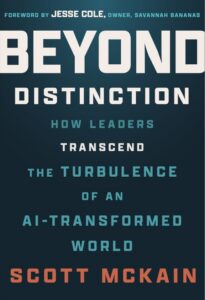
Scott McKain has spent his career studying what happens after differentiation stops working—and in his new book, Beyond Distinction: How Leaders Transcend the Turbulence of an AI-Transformed World, he’s landed on something that matters more than being different. He calls it transcendence, and it’s not a new buzzword. It’s what keeps organizations relevant when AI rewrites the rules faster than any planning cycle can predict.
I wanted to talk with Scott because he’s lived this work for many years. He’s guided real organizations through actual disruptions (not as theory, but as survival and growth). He’s a very deep thinker and he cuts through the noise about transformation and gets to what leaders actually need: frameworks that hold up when the next wave hits, ways to build loyalty that outlast tactics, a path forward that doesn’t require reinvention every other Thursday.
In his new book, Beyond Distinction, Scott shifts the focus from branding tactics to leadership responsibility. Customer experience is no longer a service initiative to optimize. It is a leadership decision that reflects how an organization thinks and acts. The foreword by Jesse Cole reinforces that idea from a different arena, showing how deliberate choices can create relevance competitors can’t easily copy.
Beyond Distinction: How Leaders Transcend the Turbulence of an AI-Transformed World challenges leaders to move past “different” and build something more durable. Something worth choosing again.
What follows is a conversation about why standing out isn’t enough anymore, how AI challenges what we thought we knew about competitive advantage, and what it takes to build something that lasts. If you’re tired of strategies that burn bright and then fade fast, you’ll appreciate our conversation and his book.
Scott, I’ve watched your thinking evolve from All Business is Show Business all the way through Iconic and now Beyond Distinction. What’s the throughline connecting that teenager in the Crothersville grocery store to the global thought leader you are today?
The throughline is remarkably simple—even if the world around it has changed at breathtaking speed. Every business, in every era, ultimately faces the same challenge: earning customers who choose to stay, who spend more, and who willingly tell others about their experience. That hasn’t changed since the days of the corner grocery store.
What has changed is everything surrounding that goal. The pace. The expectations. The technology. The margin for error. Moving people from point A to point B used to be a horse and buggy proposition. Today it’s a jet aircraft. Same destination. Completely different realities.
My work has never been about novelty for novelty’s sake. It’s been about understanding how human expectations evolve—and helping leaders adapt before those expectations outpace them. Beyond Distinction reflects that evolution. The destination hasn’t changed. The road absolutely has.
You’ve had an eclectic career…films, White House speeches, Farmers, dining with heads of state and you are friends with the famous musicians like the Oak Ridge Boys. How have these “off-script” experiences shaped your business thinking in ways a traditional career path never could?
Those experiences taught me something fundamental that traditional business paths often miss: people don’t fall in love with transactions—they fall in love with experiences that make them feel something.
Spending time in film and music—watching how relentlessly creators focus on the audience—made this impossible to ignore. Every decision is made through the lens of emotional impact. The same is true for great live performances. I’ve watched fans attend the same concert year after year, not only returning themselves but bringing friends along. That’s not satisfaction. That’s advocacy.
It forced a realization that has shaped all my work since: loyalty is emotional before it is rational. If there’s no feeling—no sense that you care about me—why would I return? Why would I refer you?
Those “off-script” experiences gave me a perspective I couldn’t have gained otherwise. They showed me what business looks like when the audience truly matters—and why emotion remains the ultimate competitive advantage.
When did you realize that “distinction” itself wasn’t enough?
The realization came when distinction itself began to feel…undistinctive.
At a recent National Speakers Association meeting, I counted dozens of speakers promising to help organizations “stand out.” When I first wrote The Collapse of Distinction more than twenty years ago, that conversation was rare. Today it’s everywhere. And that’s the danger.
Anything—even a powerful idea—can become commoditized. Especially when it’s stripped of meaning. Doing something different doesn’t matter if it doesn’t matter to the customer. Distinction without relevance is decoration.
What pushed this further was the acceleration caused by artificial intelligence. AI didn’t just add complexity—it created an inflection point. Standing out is no longer enough. Leaders must rise above volatility, speed, and sameness itself. That’s where Beyond Distinction was born—not as a rejection of the past, but as the necessary next step.
As Corporate Educator in Residence at High Point University, what are you learning from the next generation that’s informing your current thinking about transcendence?
One of the biggest surprises has been this: Gen Z wants human connection just as deeply as baby boomers do.
They’re fluent in technology. Comfortable with AI. Expect instant access. But when something breaks—when the process fails—they want a human response immediately. Organizations that believe automation can replace humanity aren’t just alienating older customers. They’re misunderstanding younger ones, too.
Working with students at High Point University has reinforced something essential to transcendence: technology may scale efficiency, but trust is still built person to person. And despite the cynicism we often hear, being around these students has left me deeply optimistic. The future isn’t just capable—it’s thoughtful, values-driven, and ready to lead in more human ways than we expect.
You say: “AI didn’t create instability but exposed it and accelerated the consequences.” Talk about that.
AI didn’t invent disruption—it removed the delay.
Weaknesses that once took years to surface can now be exposed overnight. Sometimes instantly. In the book, I reference how the emergence of a lower-cost AI model triggered massive market reactions—not because it was entirely new, but because it scaled capability faster than leaders expected.
AI amplifies what already exists. If your customer experience is broken, AI will allow more people to experience that failure more efficiently. If leadership is unclear, AI accelerates the confusion. Jim Rohn once said money makes you more of what you already are. AI does the same for organizations.
What makes this harder—and more important—is that everyone has access to the same technology. The differentiator isn’t the algorithm. It’s the human capacity to connect, imagine, decide, and serve. AI becomes a powerful partner, but it will never replace vision, empathy, or judgment. Transcendence happens when leaders understand that technology scales capability—but humanity creates meaning.
You’ve worked across industries (entertainment, technology, retail, professional services). Are the principles of transcendence universal?
A: Absolutely—because customers don’t compartmentalize their expectations by industry.
In research for earlier work, we found that customers compare experiences across life, not sectors. If my dentist remembers my family and my accountant doesn’t, my expectations for personal recognition don’t adjust downward just because the service category changed.
That means competition is broader than leaders think. A luxury auto dealer isn’t just competing with another dealership—it’s competing with the Ritz-Carlton, Four Seasons, and any brand that delivers exceptional care to the same customer.
Working across industries clarified this truth: transcendence isn’t situational. It’s universal. Customers are diverse, discerning, and remarkably consistent in what they value. Organizations that recognize that—and rise to meet it—are the ones that truly move beyond distinction.
Give us a concrete example: What’s one business model or leadership practice that worked in 2005 or 2015 but doesn’t fit in 2025?
A: One of the clearest examples is the leadership practice of managing by lagging indicators—running the business primarily through quarterly results, efficiency metrics, and backward-looking dashboards.
In 2005, and even into 2015, that model worked reasonably well. Markets moved slower. Customer expectations evolved gradually. Leaders could review performance, make incremental adjustments, and still stay competitive.
In 2025, that approach is dangerously outdated.
Today, by the time a problem shows up in a quarterly report, the damage has already been done. Trust has eroded. Customers have left. Employees have disengaged. AI didn’t create that risk—but it dramatically shortened the time between cause and consequence.
The organizations that thrive now don’t wait for indicators; they operate on signals. They pay attention to friction, confusion, hesitation, and emotional response in real time. Leadership has shifted from optimization to anticipation—from managing outcomes to shaping experiences before metrics ever move.
That’s a fundamental shift. What once felt like disciplined leadership now looks reactive. In a world moving at digital speed, leaders who only look backward are effectively steering by the wake, not the horizon. That’s why going “beyond distinction” is imperative.
Check out: Beyond Distinction: How Leaders Transcend the Turbulence of an AI-Transformed World
Image Credit: Giorgio Trovato