
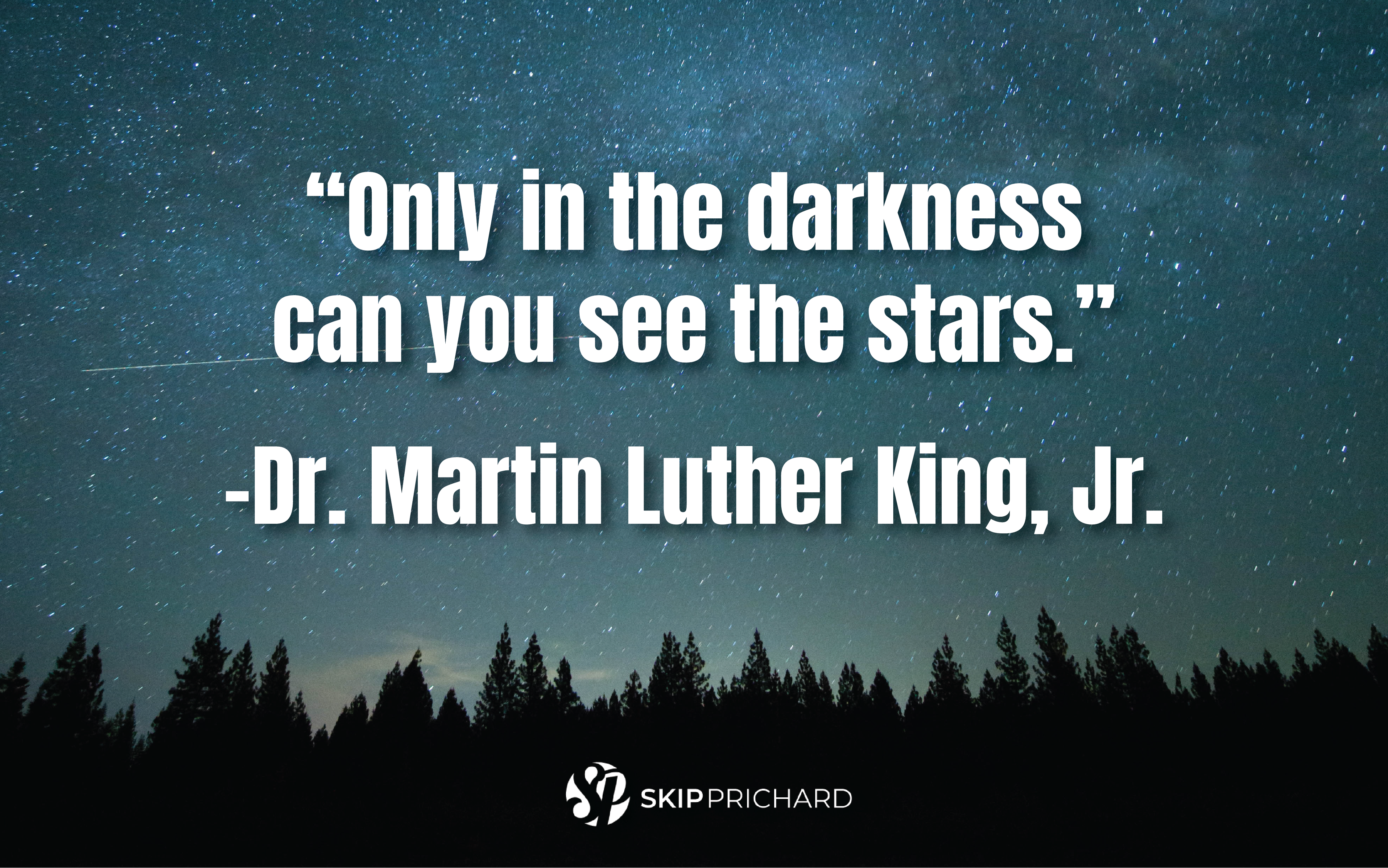
Only in the Darkness Can You See the Stars
I can close my eyes and hear his voice. That cadence. The way he turned words into poetry and poetry into action. Dr. Martin Luther King Jr. painted pictures of justice. He made you see it, made you believe it was possible even when everything around suggested otherwise.
Today we remember not just a man, but a way of moving through the world that remains as relevant now as it was in 1963.
The Paradox of Darkness
Dr. King understood something most leaders miss: darkness isn’t just obstacle. It’s also condition. You can’t see stars in daylight. You need the darkness to reveal what’s actually there, always there, just invisible until conditions make it visible.
This wasn’t optimism for its own sake. It was strategic hope. The kind that acknowledges difficulty while refusing to let difficulty have the final word.
When he looked at Birmingham, stood in Selma, wrote from a jail cell. He wasn’t pretending things were fine. He was choosing to see what was possible beyond what was present. That’s different from denial. That’s vision.
Love as Strategy
What strikes me most about Dr. King’s leadership is how he responded to hate with love. It was a tactic (but so much more). He said, “Let us not seek to satisfy our thirst for freedom by drinking from the cup of bitterness and hatred.”
That’s not passive or weak. That’s one of the hardest strategic choices a leader can make.
Bitterness is easy. Hatred is natural when you’ve been treated unfairly. But Dr. King understood that bitterness would poison the movement from the inside. That hatred would turn freedom fighters into the very thing they were fighting against. So he chose something harder. He chose love as the weapon that couldn’t be turned against itself.
For modern leaders, this translates directly: how you respond to opposition defines you more than the opposition itself. You can win a battle with bitterness and lose your soul in the process. Or you can win the right way…with strength…and without becoming the thing you oppose.
Pointed and Yet Hopeful
Dr. King’s words were never soft. He didn’t traffic in comfortable truths or polite suggestions. He called injustice by its name. He pointed at systems and said “this is wrong” without equivocation.
But he never stopped there. The pointing was always paired with possibility. “I have a dream” wasn’t just diagnosis—it was direction. This is what’s broken. And here’s what it could become.
That balance of being pointed and yet hopeful, challenging and yet positive is what made him effective. He didn’t let people look away from difficulty. But he also didn’t leave them drowning in it. He showed them the stars.
Leaders who only diagnose problems without offering vision create despair. Leaders who only offer vision without acknowledging reality create cynicism. Dr. King did both. That’s why people followed him into danger.
Simple and Yet Profound
One of Dr. King’s greatest gifts was his ability to take complex moral and political issues and distill them into language a child could understand. “Injustice anywhere is a threat to justice everywhere.” Nine words and complete clarity.
This wasn’t dumbing down. It was clarifying. It was cutting through the noise to name what actually mattered.
Modern leaders drown in complexity. We use jargon to sound smart. We complicate things that should be simple. We mistake verbosity for depth. Dr. King did the opposite. He made the profound simple. And in doing so, he made it accessible. Actionable. Memorable.
If you can’t explain your vision in a sentence, you don’t have a vision. You have a vague intention. Dr. King had vision.
Progress and the Long Arc
We celebrate Dr. King’s memory today, and we should.
He said, “The arc of the moral universe is long, but it bends toward justice.” Long. Not immediate. Not automatic. It bends because people bend it. Through choices and showing up. Through refusing to let darkness have the final word.
Progress isn’t inevitable. It’s chosen by people who decide that today matters. That their choices matter. That even when you can’t see the full path, you can take the next step.
The Stars Are Still There
Here’s what I come back to on days when things feel impossibly dark: the stars don’t disappear in daylight. They’re still there. You just can’t see them.
Dr. King’s genius was helping people see what was already true but invisible. That their dignity existed whether the law recognized it or not. That their worth wasn’t determined by how they were treated. That the future could be different because people could choose differently.
The darkness he walked through was real. We know that the hatred was real. The violence was also real…but so were the stars. And he kept pointing at them until other people could see them too.
Hope as a Discipline
Dr. King didn’t live to see a Black president. He didn’t see the progress we’ve made, incomplete as it is. But his hope wasn’t conditional on seeing results. It was grounded in something deeper: the conviction that doing right is worth doing regardless of outcome.
That’s the kind of hope that builds movements. That changes systems and that outlasts the people who carry it.
The darkness is real. But so are the stars.
Keep dreaming. Keep looking up.