

Performance Under Pressure
Pressure does something to people. It focuses the mind, speeds up the story we tell ourselves, and makes the next moment feel heavier than it needs to be. In sports, that pressure is public and immediate. In leadership, it can be quieter, but it is no less real. A tough meeting, a big presentation, a setback you did not expect, a team looking to you for steadiness. Those are your ninth innings.
Joshua Lifrak spent years helping elite athletes strengthen their mental game, including players in the Chicago Cubs organization during their 2016 championship season. What interests me most about Joshua’s work is that he does not talk about mindset as a slogan or a pep talk. He treats it as training. Something you can practice, repeat, and build, especially when the day is not going your way.
His book, Win Today: Six Steps to Mental Resilience, Peak Performance, and a Thriving Life, is built around a simple idea that many of us forget when we are under stress. The next play matters more than the last one. You can reset. You can choose your focus. You can decide how you want to show up, even when circumstances are messy.
I asked Joshua what he learned from the Cubs, how he helps people handle negativity without pretending it is not there, and which practices translate best from the field to the boardroom and home. Here is our conversation.
You have spent your career working with some of the most elite athletes in the world, including players in the Chicago Cubs organization during their historic 2016 World Series run. What did that experience teach you about mental resilience that you couldn’t have learned anywhere else?
The biggest lesson I learned during that time, which I describe in WIN TODAY, is that the support of your teammates and your connection with others is paramount to taking resiliency to the next levels. There is a quote attributed to Albert Einstein, “There are things that count that cannot be counted,” that comes to mind when I think about that time.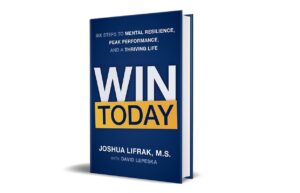
There was a cumulative cultural belief that we all had. There was a feeling of destiny that drove us, and there was an extreme lack of negativity when things got tough. We never wavered, and the players and staff—while they may have gotten stressed—never allowed the tension or pressure to overwhelm their sense of self and their sense of purpose.
The lesson I learned is that you need to trust others to achieve amazing things and if you are working toward a historic event, there is no room for negativity. The other lesson I learned is that a small group of dedicated, focused, and connected people can truly change the world. There are now five million Chicago Cubs fans that know that the impossible is now possible.
Your book is called Win Today and the title carries a specific intentionality. Why today versus longer-term?
There are a couple reasons for looking at today versus longer term.
I thought a lot about the book title. Here’s why I decided to call it WIN TODAY. The first reason is that today is all we really have. It is here and now. That is where true performance and greatness reveals itself in the present moment. So why not win right here and right now. That is today.
The other reason is that if you want to achieve great things in the future you must take care of what is in front of you repeatedly. I call it the aggregate of marginal gains…in other words, little by little becomes a lot. The overnight success is usually created by 20 years of hard work, right?
The last reason for the WIN TODAY book title is that I heard the phrase “win the day” years ago when Chip Kelly was coaching the University of Oregon football team. I liked the idea, but I thought it was not specific enough. I mean what day are we trying to win? Christmas, three weeks from now? The day was too vague. I find that the more specific and clear you are, the more purpose and velocity people work with. WIN TODAY is clear. We are competing in the here and now and when we win that, we reset and we go again. Consistency over intensity.
You write about The Negativity Shot Clock and our minds default to negativity. Talk about this tool and how you use it.
The Negativity Shot Clock is a tool of control. I found when working with athletes who perform in a world where there is a plethora of things that they have no control over and affect the outcomes of their work, that anything the athletes can control will help them.
We all get emotional when we care about the outcome of our labors. The thing is that we do not want to fight against the emotions—we will lose that battle. Instead, what we want to do is accept the feelings and then work to move past them if they do not serve us. So, when an athlete is frustrated, angry, or negative I don’t say “get positive.” That athlete would then just get angrier. Never in the history of saying “hey, calm down” or “be positive” has that worked. So, the better step is to give the athlete the permission to be emotional and then take control of it. Most athletes understand what a shot clock is. The key is they get to set their own shot clock, and then they get to decide to move past the emotion. Instead of being a victim to feelings, they are now a victor of their own choices. They take back control of their attitude and focus. Control what you can control, influence what you can influence, and then let the chips fall where they may.
Most people understand that mindset matters but struggle to do anything practical with that knowledge. What is the most common mistake people make when they try to develop mental resilience on their own?
The most common mistake is that they believe that resilience cannot be trained. I have seen first-hand people who develop the ability to bounce back, to overcome, and to thrive.
Positive mindset is trained through specific exercises that help strengthen the neural pathways that are responsible for resiliency. If you do the work, then the work will work on you.
The second thing is that, the more often you do these exercises, the stronger your adversity tolerance and resiliency will become.
The other mistake people make is that they think resiliency is mental magic. It is not. It is consistency of work that creates transformation. Transformation starts quickly with the choice to do the work and the choice to grow. As my mentor Trevor Moawad used to say, “Change is inevitable, but growth is optional.”
Let’s talk about “in blue, out red.’ You help players retrain their minds to focus on breath by visualizing a cool color such as blue when they inhale and then a warm color leaving the body. Tell me more about this and how it works.
This exercise allows for control. I have witnessed coaches reminding players to breathe in moments of stress and tension and then watch the player inhale and exhale like they were preparing to attempt a world record dead lift. They would be adding tension instead of releasing. What dawned on me was that athletes had not been trained on how to breathe to take control of emotions and stress.
In addition, if you have ever sat in a meditation where you are instructed to focus on your breathing and then left in silence for five minutes, you can relate to how fast the mind starts jumping all over the place. “How much time do I have?” “I have an itch.” “Did I shut the oven off?” “Did I put that appointment in my calendar?” “I have to call my wife after this, etc.”
So I wanted to help athletes have an anchor to attach to and come back to when they noticed they had gotten distracted. By coloring the breath, they were bringing their focus to mentally seeing the inhale and exhale, thus focusing on breathing and breathing with control. Our coaches could now simply say “In blue, out red,” and the players knew to breathe slow and deep and thus begin the process of releasing tension and gaining control of their emotions. “In blue, out red” works for everyone in a stressful situation, whether at work, home, or play.
You added something to your thinking after a conversation with Tim Tebow on connections, and you surprisingly linked it to sardines. I found that concept fascinating and would love you to share more.
It’s all about strength and safety in numbers. In the natural world, vulnerable species group together to protect themselves from predators.
Connection and being a part of a large group is a survival instinct. Our brains have the job of keeping us alive as its primary task. Survival is not thriving. So it is interesting that Tim brought up that he felt like connection was also a part of the brain’s major functions. If you step back and note survival is that major function, then it makes complete sense we would desire connection. I also think about greatness in the world and amazing accomplishments. For the life of me, I cannot think of one amazing thing that humans have done in the world alone. Even summiting Mt. Everest or running the 4-minute mile involved others who were there to support or witness or time, etc. We need each other to achieve.
The six steps in your framework build on each other in a specific sequence. Was that sequence something you discovered through your work with athletes or did it emerge from other research?
The six steps outlined in WIN Today do not need to be completed in order. You can do them in any order, and if you do at least four of them a day, then you win. If you do four, you get a 4-2 victory.
I have found, however, that “defining your story” is a good place to start your day and “Mile Zero” is a good place to end your day. Again, though, they can happen in any order.
I look at the sequence as more of a developmental path. In other words, I start with some of the easier concepts to activate. “Defining Your Story” is simply choosing an intention which can take about five seconds to do. “Stopping the Storm” and “Defeating Negativity” can take a little more focus, energy, and awareness, and are thus a little more complex. While there is a sense of building upon each other, once you understand the steps, you can do them anytime, anywhere.
You focus on athletes, but the concepts clearly apply to anyone seeking peak performance. How have you seen these ideas applied outside of sports?
In WIN TODAY, I write about applying the tools to everyday life. What I saw time and time again in professional sports is that those who used the tools were more grounded. They were able to respond quicker to setbacks and move forward faster. They were also able to stay in the moment longer, notice when they were not in the moment, and adjust rapidly. In addition, while they had emotional reactions to events, they were able to get to neutral and logic more seamlessly and thus get back to performance.
Executives who use these concepts are affected in a similar way. They become more empathetic, better listeners, and clearer about vision and mission. I have also seen people’s relationships with their families improve as they are less reactive and more thoughtful. They become more curious rather than judgmental.
Lastly, I have noticed that outside of sports people are able to live life the way they want —energized, focused, creative, caring and engaged. They live with more purpose and live their lives on their own terms by design, rather than living by default.
While the tools are designed to help people perform better in performance environments, they also have a residual effect on their day to day lives as well.
You work extensively in baseball, a sport defined by failure where even the best hitters fail seven out of ten times. What has baseball specifically taught you about building a resilient mindset that other sports haven’t?
The wins are everywhere. In baseball sometimes even when you do not get a hit you can win at bat. Sometimes when you get out, you can win at bat. Sometimes when you walk a player, it helps the team and is a bit of a win.
I think what baseball taught me is that, when you get into the process of winning rather than the outcomes of winning, it can increase your ability to deal with “failure.” There are so many little wins in the game that the key is to do those little winning things repeatedly, and then there is a better chance of winning the game.
The other thing that baseball taught me is that you could do everything right and have an outcome categorized as a “failure.” Resilience is strengthened by examining with logic the execution of a process, rather than the results. By examining with logic, the ability to step into a situation optimistically and with belief that is stacked against the player increases. Thus, resilience—the ability to face failure and keep coming back—is strengthened.
There is a concept in your work around the idea of controlling what you can control, which sounds simple until you actually try to do it under pressure. What does that practice really look like in the moment when everything feels like its falling apart? What is important now?
There is a classic sport psychology acronym—WIN: What’s important now? When athletes focus on what they can control, they also focus on what is important.
They just had a turnover, they sprint back on defense in basketball. They just made an error, they reset and position themselves for the next pitch. They got beat on defense, their job now is to set a great pick and roll off it. These are just some examples from basketball and baseball, but in any performance, there are a number of key focal points and things to focus on that will increase the chances of success. That is what “controlling the controllables” is all about. Where do I put my focus? Where is my energy level? What am I saying to myself? We dominate those aspects and typically the physical preparation will allow us to perform at our highest in the most pressure.
Self talk is a thread that runs through everything you teach. What does healthy self talk actually sound like and how is it different from positive affirmations?
There are different types of self-talk. There is execution focus talk, such as “keep your elbow in or stay low, or eyes up.” They are physical reminders of what to do. There is energy and belief self-talk. “Today is my day. I belong here. Be aggressive.”
Affirmations tend to be about confidence and identity more than the process of execution. So “I am a winner or I am a great scorer” are outcome based but also identity based. The best self-talk is what Rhyne Sandberg once told me. The key to the mental game is “getting ready to be ready.”
What we want to do is take a process that has been thought out and is more of a response and turn it into immediate reactions. I consulted for an Indy Car racing team. These drivers go 240 mph on a razor thin wire above a pool of chaos, so they do not have time to think through stuff. They are in full reaction mode in races. They plan their responses and play out their scenarios in the mind prior to strapping on their helmets. Their self-talk is more of a trigger for reactions. They might say, “eyes up get inside” and then their bodies will take over. The most effective self-talk will increase belief, drive clear focus, and help athletes get to optimal energy states.
If someone reads Win Today and can only take one of the six steps and apply it starting today, which one would you point them toward and why?
I would point them toward “Define Your Story.” This step is the first in the book and it is about defining who you are in this world. It is about setting an intention and deciding what you want from life instead of living life in a default victim mode. This is happening for me instead of this is happening to me mindset. When you take control of deciding who you want to be, you are starting the process of defining your life. In addition, this is a very easy tool to use.
You simply decide when and where you will create an intention for the day. Then write it down or say it out loud to yourself. The entire process of setting an intention takes maybe five seconds. For example, I decided today to be focused, joyful and productive.
Now I have a picture of what that looks like in my mind and I also have a lighthouse to come back to if I get away from that being. It gives me an anchor for the day instead of chasing the day. I am determining how I will respond to my day.
You have dedicated your career to helping people perform at their best when it matters most. What has doing this work done to your own understanding of what it means to live well, not just perform well (since Thriving Life is the last part of the subtitle)?
Being around exceptional human beings has been humbling and awe inspiring at the same time. It has taught me that the impossible is possible and that people, no matter what they are doing and who they are doing it in front of, are people. They cry. They have fear.
They wilt and then they bounce back.
Being around elite athletes has shown me it is never about not having negativity, or lack of focus, or lack of belief. It is about catching yourself thinking bad or being too emotional quickly and adjusting that mindset. It is about the power of noticing and the agility to adapt when you do notice and that is all. The best athletes simply notice and adapt quicker than the average great athlete. Thriving is about having the grace to accept emotions and then taking control and adjusting to logic. It’s finally about deciding to look for things to be grateful for. The best athletes truly appreciate where they are and what they are doing. They love the process and actively note that.
Joshua’s ideas land because they are practical. They give you something to do in the moment, and something to practice before the moment arrives. I also appreciate that his work keeps pointing back to the same quiet truth. You do not need a perfect day to show up well. You need a reset, an intention, and the willingness to return to what matters.
If you are carrying pressure right now, take one small step from this conversation and try it in the next ordinary moment. Those are the moments that shape you. Little by little becomes a lot, and the way you respond today has a way of becoming the way you respond tomorrow.
For more information, see Win Today: Six Steps to Mental Resilience, Peak Performance, and a Thriving Life.
Image Credit: nghia-le