

Oleg Konovalov has spent years watching brilliant leaders fail in ways that had nothing to do with their competitors, their markets, or their resources. The failure was happening inside their own heads. After thousands of conversations with executives across industries and continents, he landed on a number that should stop every leader: 76% of leaders operate in a state of chaotic thinking, and most of them have no idea it’s happening because they’ve learned to call it something else entirely. They call it busy. They call it responsive.
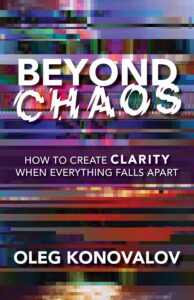
What Oleg has written in Beyond Chaos is a reckoning with an underexamined problem in leadership today. Chaos isn’t just the market conditions or the geopolitical noise or the relentless pace of technological change. It’s the fragmentation that happens in a leader’s mind when the speed of change finally outpaces the capacity to think clearly about it.
I found this conversation with him genuinely worth your time, because the questions he raises don’t stay theoretical. They become personal very quickly.
- What pivotal moment led you to write Beyond Chaos, and why now?
The pivotal moment was realizing that leaders weren’t losing to competitors — they were losing to their own thinking. I kept seeing the same pattern: smart people, strong companies, massive opportunity — and internal confusion destroying it all.
Chaos takes one’s agency over life away and makes that person unable to deal with life.
That is not just personal. It’s organizational. Between 2017 and 2025, disruption didn’t rise — it exploded. AI, geopolitical shocks, economic volatility. The level of disruption increased dramatically. Leaders were drowning in noise.
And here is the truth: Chaos is not about events but about the way we think and act.
The world didn’t suddenly become unmanageable. Our thinking did. That’s why now.
- In The Vision Code, you said only 0.1% of leaders have true vision. Now 76% have chaos in their thinking. Are these related?
Absolutely. If 76% of leaders operate in chaos, it explains why only 0.1% sustain real vision.
Vision requires structured thought. Chaos destroys structure. When you tell everyone that everything is a priority, you might as well say nothing is a priority.
Vision demands clarity of priority. Chaos multiplies priorities. If chaos is given to us, clarity is what we create ourselves. The few who create clarity are the few who sustain vision.
- What shifted your focus from vision to chaos and clarity?
The pace of change became faster than the leaders’ cognitive processing capacity. The speed of change now outpaces the growth of leadership capacity.
We moved from VUCA to BANI. Attention spans collapsed. Reactivity replaced reflection. I saw leaders constantly responding to noise — every ping, every headline, every crisis.
The greater the chaos, the smaller the thoughts. When thinking shrinks, vision disappears.
Before leaders can build the future, they must regain control of their minds.
- Must leaders master clarity before vision?
Vision without clarity is fantasy. Clarity without vision is maintenance. Clarity is the foundation.
Clarity is not a slogan or something vague. Clarity is a leadership resource. It defines solutions. It builds the bridge between the present and the future.
Clarity stands on simplicity. And simplicity is the religion of leaders. Without simplicity, there is no clarity. Without clarity, there is no vision.
- How did you arrive at 76% and what was your reaction?
It took me more than three years — and thousands of interviews, executive conversations, board discussions, and leadership workshops across continents — to arrive at that number.
I didn’t start with a statistic. I started with a question:
 Why do capable leaders keep underperforming in moments that demand clarity?
Over time, unmistakable patterns surfaced. Fragmented priorities. Emotional volatility.
Reactive decision-making. Constant urgency. An inability to sit in silence and think.
Roughly three out of four leaders demonstrated some form of chaotic thinking.
My reaction? Concern — not judgment. Not because leaders lack intelligence, but because chaos has become normalized.
That is how the 76% emerged — not from theory or abstraction, but from repeated patterns observed across industries, cultures, and levels of seniority.
Chaos has become the norm. Leaders call it “busy.” They call it “agile.” They call it “modern leadership.” But it is not agility — it is fragmentation.
We are facing a silently growing pandemic of chaos in thinking. The most dangerous problem is not the one we see. It’s the one we accept as normal.
- Talk about your definition of chaos.
Chaos in thinking is the inability or difficulty in processing an increasing number of conflicting variables in life and business, which demands a frequent change of mental models.
Leaders today face broken scripts. Yesterday’s model doesn’t solve today’s problem. An unstructured world is not the problem. An unstructured mind is.
The challenge is this: How do you bring structure to an unstructured world?
Chaos is not disorder outside. It’s fragmentation inside.
- Why call it chaos-addiction?
Because many leaders don’t just suffer chaos — they create it. Drama produces stimulation. Urgency feeds ego. Busyness feels important. Some leaders are uncomfortable in calm.
Chaos in thinking is contagious. Many people “don’t know what it is to be in stillness.” When chaos becomes your norm, peace feels unfamiliar. That is addiction.
- Which interview changed your understanding most?
Lt. Colonel Daniel Bell. In combat, chaos is lethal. Panic costs lives. He learned that the leader must be the calmest person in the storm. Panic in chaos breeds more chaos.
Leadership is emotional regulation under pressure. Business is not a battlefield — but psychologically, the principle is identical.
- Why connect ancient gods of chaos with VUCA and BANI?
Chaos is ancient. Civilizations gave it names — Apophis, Loki, Tiamat — because humanity has always needed to identify what it fears and struggles to control. Today, we call it VUCA and BANI.
But the fear is the same. We used to sacrifice to the gods of chaos. Today, we sacrifice our attention, peace, and clarity. Across generations, one truth remains: Chaos is a thief of the future. Different names. Same enemy.
- One specific technique that works everywhere?
Intentional silence. Chapter Seven is built around this principle. In silence, we think deeply, create boldly, innovate truthfully, and, most importantly, listen.
Silence interrupts reactivity. It shifts you from survival mode to strategic mode.
Without pause, you react.
With pause, you lead.
Pause is the shortest path to win.
- How can leaders distinguish self-created chaos from external chaos?
Ask yourself: Is this complexity unavoidable — or self-inflicted?
External chaos:
- War
- Market crashes
- Global pandemics
Internal chaos:
- Constantly shifting priorities
- Emotional outbursts
- Undefined direction
Leadership success depends on owning the moment. If clarity reduces confusion, the chaos was internal. Most organizational chaos is amplified — not imposed.
- “To lead in chaos, you must first lead yourself.” How do you balance that?
External events are triggers. Internal reactions multiply impact.
Self-leadership means managing emotions, protecting attention, and structuring thinking. Because when a mind is in chaos, we tend to switch to survival mode.
Survival mode cannot build a strategy. Organizations reflect leadership psychology.
Fragmented leader — fragmented culture.
- How does clarity bridge chaos and structure?
Clarity filters noise, defines priorities, and aligns action.
Chaos is unstructured input. Structure is disciplined output. Clarity is the transformation process. Structured thinking is a feature of a productive mindset. Clarity is disciplined thinking under pressure.
- Guidance for leaders navigating AI integration?
AI increases speed. It does not increase wisdom. Use AI to expand analysis — not replace judgment.
It is not AI itself that can ruin a person, but rather how we use it. Without clarity, AI accelerates chaos. With clarity, AI accelerates execution. Technology amplifies mindset. AI does not improve leadership. AI exposes leadership capacity.
- How can leaders protect themselves from intrusive noise?
There are three disciplines to follow:
- Scheduled information intake.
- Ruthless elimination of non-essential alerts.
- Clear priority filters.
Remember that your mind is not a dustbin for collecting sick opinions. Protect cognitive bandwidth like capital. Because it is.
- If readers take one action, what should it be?
Eliminate three distractions. Define one priority.
Don’t feed chaos. Create clarity and feed your aspirations for the future. If chaos is given to us, clarity is what we create ourselves.
Leadership today is not about avoiding chaos. It is about leading with clarity.
Clarity is the leader’s ability to reduce complexity into direction and hold that direction long enough for others to act.
Clarity is a system for finding a way out of present chaos. Clarity is not comfort. It is command.
Beyond Chaos
Image Credit: brett jordan