
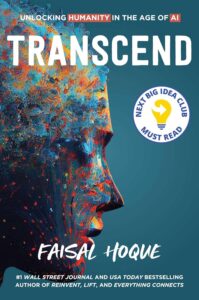
In a time when artificial intelligence dominates headlines and boardroom agendas, Faisal Hoque urges us to pause and not to fear the machines, but to understand ourselves. In his new book, Transcend, Hoque doesn’t offer predictions about singularity or promises of AI salvation. He offers something more lasting: perspective. Drawing on philosophy and strategic frameworks, he challenges us to rethink what it means to be human in the age of intelligent machines.
Faisal Hoque is no stranger to these big questions. A seasoned entrepreneur and author of bestselling titles like Everything Connects, he has long explored the intersections of leadership, purpose, and technology. His latest work extends that journey into new and vital terrain.
You’ve written about transformation and innovation for years (and I have interviewed you on these subjects). What made you feel this was the moment to write Transcend?
We’re living through a moment of profound acceleration—not just technological, but existential. AI is advancing faster than our wisdom to guide it. I wrote TRANSCEND because I believe we’re at a crossroads where we must choose: Will we let technology define us, or will we define how technology serves our highest human potential? This book is my call to pause, breathe deeply, and remember that the most important transformation happens within us first.
In your introduction, you compare AI to the philosopher’s stone. What lessons should we draw from that metaphor?
The philosopher’s stone represents humanity’s eternal quest—not just for external power, but for inner transformation. The alchemists understood something we’ve forgotten: true magic isn’t about manipulating the world; it’s about elevating consciousness. AI offers us unprecedented capabilities, but without inner work, we risk becoming prisoners of our own creation. The real gold we seek isn’t efficiency—it’s wisdom.
Many books on AI focus on technology. Yours focuses first on humanity (which I loved). Why did you take that route?
Because technology without consciousness is just sophisticated automation. I’ve spent decades studying innovation, and I’ve learned that every breakthrough begins with a human insight, a moment of awareness. By starting with humanity, we anchor AI development in what matters most: our capacity for love, creativity, and transcendence. The question isn’t “What can AI do?” but “Who are we becoming as we build it?”
You introduce the OPEN and CARE frameworks. Why did you feel both were necessary—and how do they complement each other?
 We created both because navigating AI requires different states of consciousness:
- OPEN (Outline, Partner, Experiment, Navigate) embodies the explorer’s mindset—curious, optimistic, possibility-focused. It’s about expanding what’s possible.
- CARE (Catastrophize, Assess, Regulate, Exit) embodies the guardian’s wisdom—cautious, protective, responsibility-focused. It’s about preserving what’s precious.
AI is simultaneously our greatest opportunity and our greatest risk. Wisdom lies not in choosing one perspective, but in dancing between them—embracing possibility while honoring responsibility.
How can individuals apply the OPEN framework in everyday decisions, not just in corporate settings?
OPEN isn’t just a framework—it’s a mindset shift from passive consumption to conscious co-creation with AI. Outline your authentic goals, not society’s expectations. Partner with AI like you would a thoughtful colleague—curious, respectful, purposeful. Experiment fearlessly but mindfully, treating each interaction as learning. Navigate by regularly asking: “Is this technology serving my humanity or replacing it?” Start small, stay human, and remember: you’re not optimizing your life—you’re authoring it.
How do you define human freedom in the context of AI, and why is it at risk?
Freedom isn’t just about choice—it’s about conscious choice. When algorithms predict our preferences before we know them ourselves, or when convenience becomes compulsion, we surrender our agency incrementally. True freedom requires us to pause and ask: “Am I choosing this, or is it choosing me?” The deepest freedom is the ability to shape our own consciousness, to remain the authors of our inner lives even as AI reshapes our outer world.
You mention Aristotle’s philosophy. How does the concept of moderation influence your view of AI governance?
Aristotle’s Golden Mean isn’t about compromise—it’s about dynamic balance. In AI governance, this means neither blind techno-optimism nor paralyzing fear, but conscious navigation between extremes. True moderation requires constant recalibration, asking: “Are we moving too fast or too slow? Too open or too closed?” Wisdom lies in the tension between innovation and restraint, progress and reflection.
What does it mean to “detach and devote” and how can this become a daily practice?
“Detach and devote” is ancient wisdom for modern challenges. Detach from the noise—endless notifications, reactive thinking, ego-driven decisions. Then devote yourself to what truly matters—deep relationships, meaningful work, authentic growth. Start each day by asking: “What am I detaching from today, and what deserves my devotion?” This isn’t self-help; it’s self-leadership—the foundation of conscious living in an unconscious world.
You’ve written that AI is a mirror. What truths do you think it’s already showing us about ourselves?
AI is our most honest mirror, reflecting both our brilliance and our blindness. It shows us how quickly we chase efficiency over meaning, how easily we mistake information for wisdom. It reveals our unconscious biases, our addiction to convenience, our fear of slowness and silence. But it also shows our incredible capacity for creation, connection, and transcendence. The question isn’t what AI reveals—it’s whether we have the courage to look.
How do you advise companies to balance automation with human-centered culture?
Use automation to remove friction, not feeling. Technology should amplify human potential, not replace human presence. The companies that thrive will be those that understand a fundamental truth: culture doesn’t come from code—it comes from consciousness. Every automation decision is a values decision. Ask not “Can we automate this?” but “Should we?” and “What human capacity are we protecting or enhancing by doing so?”
You suggest that value judgments are unavoidable. How can organizations become more thoughtful and transparent about the values driving their AI strategies?
Values can’t just live in mission statements—they must breathe through every algorithm, every interface, every deployment decision. This means naming your values explicitly, measuring alignment constantly, and inviting stakeholders to hold you accountable. Create “values stress tests” for every AI initiative. The question isn’t whether your technology works, but whether it works for human flourishing.
You’ve interviewed and worked with many leaders. How do the most grounded leaders approach all of the changes we face?
They don’t chase trends—they lead with timeless principles. In a world of constant noise, they cultivate inner stillness. In an age of reaction, they choose response. They understand that leadership isn’t about having all the answers—it’s about asking better questions. They listen more than they speak, reflect before they react, and remember that in times of disruption, consciousness isn’t a luxury—it’s a superpower.
In the age of ChatGPT and Claude, how should we think about originality and authorship?
In the age of AI, originality isn’t about generating content—it’s about generating meaning. Machines can remix information, but they cannot replicate the alchemy of human experience: your struggles, insights, and the unique lens through which you see the world. True authorship today means bringing your consciousness to the collaboration. AI can be your research assistant, but only you can be the author of your authentic voice and lived wisdom.
If someone only takes one idea from Transcend, what do you hope it is?
That we are not powerless—we still choose what kind of humans we want to be in the age of AI. Every moment offers us a choice: Will we let technology diminish our humanity, or will we use it to amplify our highest capacities? TRANSCEND isn’t just about managing AI—it’s about transcending our own limitations. The frameworks are guides, but the real work is inner work. Because the future isn’t happening to us—we’re creating it, one conscious choice at a time.
Image Credit: tom parkes