

Lessons that built iconic brands
Some opportunities look like luck from the outside. Inside the story, they usually look like attention, preparation, and the courage to act when the moment arrives.
Ron Rubin has built a career around that kind of practical optimism, first in his family’s liquor distribution business, then as the leader behind The Republic of Tea, and later as the owner of River Road Family Vineyards and Winery. What stands out to me is how grounded his lessons are. Ron talks about mentors, reading, risk, innovation, and culture in ways that feel lived, tested, and refined over time.
His new book, Gold in Your Backyard: Lessons in Life, Leadership and the Power of a Dream, is built around a simple idea that many leaders forget when they are chasing the next big thing. The most valuable lessons and opportunities often sit closer than we think, sometimes in the people who shaped us, the customers right in front of us, or the habits we practice every day.
I asked Ron about debt, instinct, customer trust, crisis planning, innovation, learning, and the long view of leadership. Here is our conversation.
Ron, your dad built Central Wholesale Liquor on a single governing principle Dave Ramsey would love: no debt. And yet when you bought The Republic of Tea you went into heavy debt to do it. How did you reconcile that with everything your father had taught you?
Ron Rubin: I stayed true to my father’s principle, because our first goal at The Republic of Tea was to pay off the debt. I reconciled borrowing money to buy the company with my father’s no debt philosophy by not thinking about how big a company we could grow. Instead I thought about how quickly could we pay off the debt. I worked with my team to create a step-by-step plan with clear goals. It took me six years, three months, and fifteen days to become debt free.
Uncle Julian’s advice was simple but profound: “You do know, Brother. You do know.” You’ve carried that for decades now. What is it about that particular message that never loses its power for you?
Ron Rubin: Uncle Julian showed me that my first impression, my gut impression was usually right. But he always reminded me that I should take twenty-four hours to think about the problem or situation. That gives me time to look at the pros and cons and have a creative mindset, before making a decision. That concept never loses its power.
You describe Frank Fourez Jr. as the finest salesman anywhere and you spent decades learning from him. What did Frank understand about selling that most miss?
Ron Rubin: Frank understood that building a deep and trusting relationship with the customer is essential. Frank knew each customer’s name, their children’s names. He knew about their families. In other words, he got to know everything about the customer on a personal basis. Then, when he was on a sales call, he always asked about their needs. He wasn’t just selling. He was trying to fill a need. I learned from him that you must first build a relationship and then discover what the customer’s needs are.
You were reading a book about how the Ziegler’s built The Republic of Tea and you decided to buy the company. Tell me more about this because it is a massive leap from reader to owner.
Ron Rubn: When I read their book, I saw that they wrote that they had designed a glass bottle for tea. But more than that, they wanted to partner with a company in the bottled water business to help distribute the tea. I was already in the bottled water business, and I thought, wow, they are talking to me. I was very interested in developing an all-natural tea in a glass bottle and I knew we could create a licensing deal with them. The point is that I felt right away that they were talking about me in their book.
The heart scare changed everything. You were lying in the hospital facing what you thought might be the end. How does a leader avoid waiting for that kind of wake-up call?
Ron Rubin: In a certain sense, there’s nothing a leader can do to avoid that kind of personal wake-up call. How do you prepare for a heart attack? But a leader can prepare for a crisis. They need to have an in-depth company crisis plan that their people can follow in case of emergency. They should also have a personal crisis plan and even one for their family. We have developed a very detailed crisis book at The Republic of Tea.
You paid Al Ries $25,000 a day which seemed insane to you at the time. And yet you say without him your companies would not be the successes they are today. What specifically did he see in your brands that you were too close to see yourself?
Ron Rubin: The major thing that Al saw was that The Republic of Tea had no tag line. That was one of the most important lessons he taught me. He helped us develop our tag line – Leading Purveyor of Premium Teas. So now if you look at any of our packaging, at our design or our website, you’ll see our tag line: Leading Purveyor of Premium Teas. That started me off in a wonderful direction and it was well worth the $25,000.
Tripp brought his 14-year-old son Richie to critique your speech, and Richie told you to ditch the suit. That’s a remarkable way to learn about knowing your audience. How has that lesson shaped the way you approach every room you walk into?
Ron Rubin: I try to do my Five P’s – Pre. Plan. Prevents. Poor Performance – which is Lesson 26 in GOLD IN YOUR BACKYARD. I do the research and learn the background of the audience I am going to speak to. I have done a lot of speaking to the Young Presidents Organization and they’re mostly in the 35 to 45-year-old range. They are just beginning parts of their leadership journeys. So that’s what I think about: what value can I bring to these young entrepreneurs. It’s the same when I speak at Culver Academies. The students are ages 14 to 18 and I have to talk about the things they know and understand. By the way, I did ditch the suit. My wife didn’t like that, but I did it anyway.
The Ginger Peach Tea Jam collaboration with Stonewall Kitchen came from an instinct that something was possible. How do you create the conditions for that kind of open-ended creative thinking inside a company?
Ron Rubin: At The Republic of Tea, we have a Sip Tank. It’s composed of three employees who are excited about innovation. They like to study new trends; go to trade events; develop creative ideas. Ideas for products like Ginger Peach Tea Jam comes from our Sip Tank. I recommend that leaders look for a few really innovative members of their team to start a small group. The group then shares their ideas with the marketing and sales teams. If you don’t have anyone like that in your company, you can hire a consultant who specializes in innovation. That’s Lesson 11 in GOLD IN YOUR BACKYARD. Consultants can be an invaluable aid to running and growing your business.
You write that in personality tests measuring risk tolerance you score about a 12 on a scale of 1 to 10. How do you personally know when you’ve crossed the line to recklessness?
Ron Rubin: The fastest way for me to know that I’ve crossed the line is when I lose a lot of money.
Your son Todd has taken The Republic of Tea into collaborations with Sony, Paramount, Disney, and even Star Wars. When you watch him lead, what do you see that tells you the culture you built is working?
Ron Rubin: I’ve worked with Todd and the team to recognize the importance of strategic planning. That’s a core part of our business. We create a strategic plan every three years. I then use the strategic plan to see where they’re going for the next three years. I can monitor their progress and whether they’re achieving their goals. That’s how I know the culture is working. In addition, we have advisory board meetings once a quarter. So we’re always reviewing our strategic planning. We ask ourselves where are we on our strategic plan. Did we accomplish it? Reviewing the strategic plan is part of every advisory board meeting.
You set a goal of reading 52 business books a year and you always read with a yellow highlighter in hand. What does that physical act of highlighting do for the way you actually retain and apply what you read? (And I am with you on this practice 100%).
Ron Rubin: The highlighter allows me to underline the critical parts of a book. That’s important because I like to reread books. So if I go back to a book years later, instead of having to read the entire book, I can read what I’ve highlighted. That saves a lot of time and helps me remember what stood out to me when I first read it. I can also see whether I used an idea or forgot about it. I like to think about what lessons I learned from reading that book. Highlighting is valuable for rereading in a quick manner.
You created The Ron Rubin School for the Entrepreneur at Culver Academies specifically for high school students, not MBA candidates. Why that age, and what do you believe gets lost if young people wait until graduate school to learn?
Ron Rubin: We’re trying to teach them financial literacy. Show them how to handle money so that when they go to college, they can set up their budget; understand what a credit card is all; why interest rates matter. Things like that.
Also, I’ve help set up a business on campus. It’s called the Rubin Café. It’s kind of the Starbucks of the campus and is run by seniors at the high school. That’s where they learn to hire or fire employees. They need to order supplies and know when they are making a profit. In other words, they handle everything in a business. It’s great training that few teenagers ever have the chance to experience.
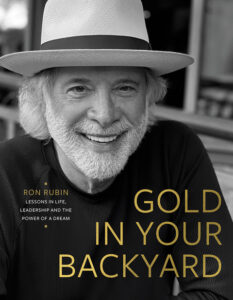 The title of the book, Gold in Your Backyard, comes from a deeply personal moment of reckoning. You write that the truest gold is found in the hearts you’ve touched. When did that realization fully land for you, and how did it change your definition of success?
Ron Rubin: Actually, the title of the book comes from something my father used to say to me. Although he encouraged me to go out and explore, he believed that what you need to learn and the people you need are not off in some distant land. Often the real gold is right in your own backyard. And he was so right.
You’ve now distilled more than 50 years of business life into these lessons. If you could go back and hand this book to the 22-year-old version of yourself walking into the family business for the first time, which single lesson do you think would have saved you the most pain?
Ron Rubin: Lesson 9 is the most important one for me. It’s about strategic planning. If I had created a road map for the business earlier, I could have followed it, right from the start. It would have saved me a lot of time and pain.
Beyond this book, you’ve built a remarkable body of work across your career and your writing. How does Gold in Your Backyard fit into everything else you’ve written and built, and what do you hope it adds to the conversation that wasn’t there before?
Ron Rubin: I wrote GOLD IN YTOUR BACKYARD to inspire others, to touch hearts and light fires. I wanted to share the many lesson I have learned during my 70-plus years on this planet. I hope that my own experiences might inspire others to follow their hearts, build their dreams, and hold deep inside themselves the magical words: We can do it! Yes we can!
Conclusion
Leadership has a way of pulling our attention toward what is distant, urgent, and loud. Ron keeps bringing it back to what is close, steady, and within reach. Pay down the debt. Take the extra day to think. Learn your customer’s world. Prepare for the crisis before it arrives. Build a plan you can review, not a dream you only talk about.
That is why Gold in Your Backyard: Lessons in Life, Leadership and the Power of a Dream resonates. It reminds us that lasting success is rarely built on one dramatic move. It is built on the decisions you repeat, the people you invest in, and the values you are willing to live out when no one is watching.